
By Makhanabazar Editorial Team | Published September 22, 2026 | 16 min read
Choosing the right makhana supplier is the single most consequential decision in your import journey. A strong supplier protects your brand's reputation, keeps documentation compliant, and ensures consistent quality across shipments. A weak one can trigger customs delays, rejected containers, and lost customers. This checklist gives you a structured way to qualify Indian makhana exporters before you place a commercial order.
1. Verify Legal and Regulatory Registrations
Start with the paperwork that proves a supplier is legally allowed to export food from India. At minimum, confirm:
- APEDA Registration — the Agricultural and Processed Food Products Export Development Authority registers and monitors makhana exporters. Ask for the registration certificate and verify the entity name matches the exporting company.
- FSSAI Central License — mandatory for Indian food exporters; confirms the facility meets national food safety standards.
- IEC (Import Export Code) — the DGFT-issued code required for any export transaction from India.
- GST Registration — confirms the supplier is a tax-compliant business entity.
Cross-check the legal entity name on all four documents. Mismatches between the APEDA holder, the FSSAI licensee, and the invoicing company are a common red flag.
2. Check the Certifications That Signal Quality
Beyond the mandatory licenses, reputable suppliers voluntarily hold certifications that demonstrate a mature food-safety system. The most relevant for makhana exports are FSSAI, ISO 22000, HACCP, and — for organic-positioned products — USDA Organic, EU Organic, or India Organic. Our quality certifications guide explains what each one actually proves to buyers.
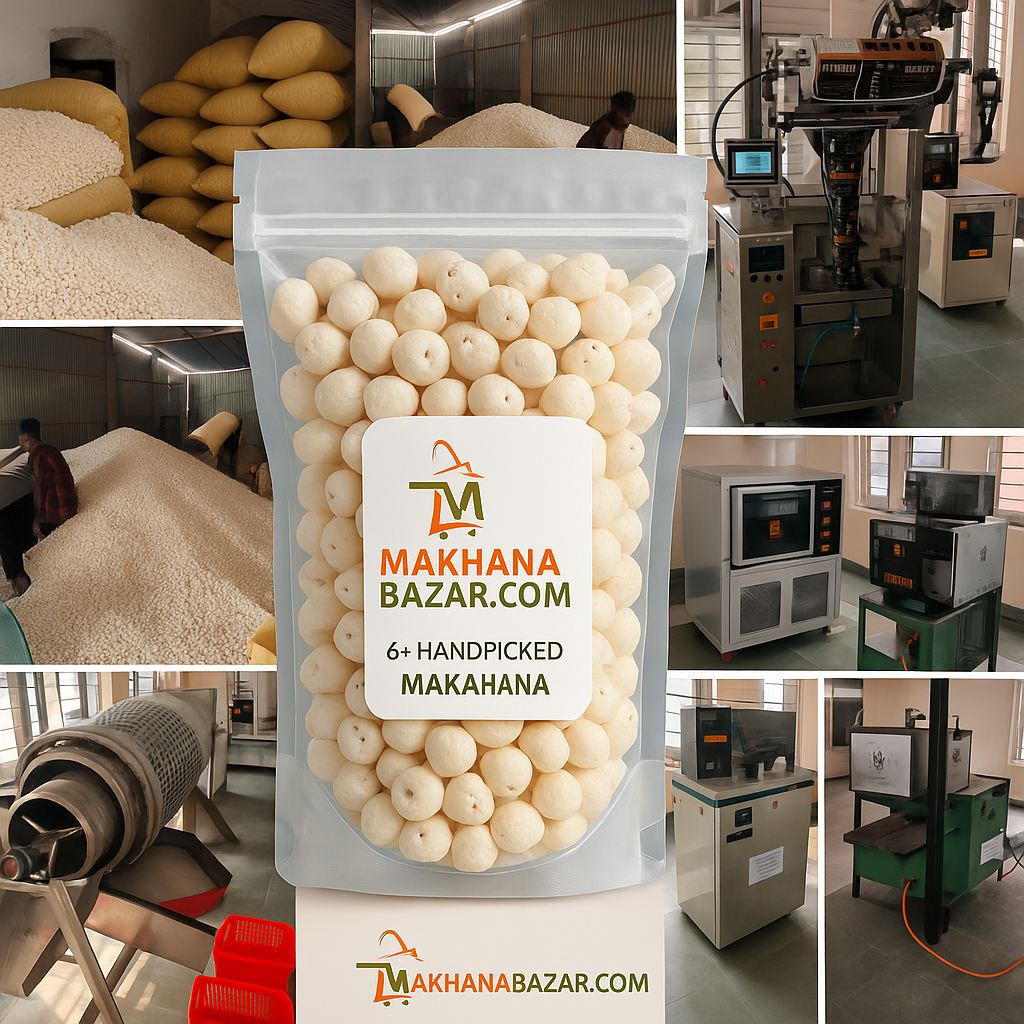
3. Evaluate Production and Processing Facilities
Request a facility overview or, ideally, schedule a virtual walkthrough. Assess:
- Grading and sorting capability (sizing by mm, removal of broken and discolored kernels).
- Roasting and flavoring lines, if you need roasted or seasoned makhana.
- In-house or partnered laboratory for moisture, heavy-metal, pesticide, and microbial testing.
- Packaging infrastructure — bulk sacks, retail pouches, and nitrogen-flush or vacuum options.
4. Request and Independently Test Samples
Never approve a supplier on a sales sample alone. Request graded samples across the sizes you intend to import (for example jumbo, premium, and regular) and have them tested at a certified third-party laboratory. Compare the lab report against the supplier's own documentation for moisture content, heavy metals, pesticide residues, and microbiology. For a detailed walkthrough of what to test, see our certifications and testing guide.
5. Assess Commercial Terms and Communication
A reliable supplier is transparent and responsive. Evaluate:
- Minimum order quantities and whether trial orders are accepted before full containers.
- Production and packing lead times, and how they shift during the October–February harvest season.
- Supported Incoterms (FOB, CIF, EXW) and whether they work with your freight forwarder.
- Payment terms and the clarity of their commercial invoices and packing lists.
6. Watch for Red Flags
| Red Flag | What It Usually Means |
|---|---|
| No APEDA or FSSAI documentation | Not a licensed exporter; customs and buyer risk |
| Refuses to share samples | Possible quality gap they don't want exposed |
| Prices far below market | Substandard grade, misgrading, or unreliable supply |
| Vague or missing lab reports | No verifiable food-safety controls |
7. Run a Step-by-Step Qualification Process
Turn the points above into a repeatable workflow:
- Collect APEDA, FSSAI, IEC, and GST documents; verify entity names match.
- Review certifications and request valid, dated certificate copies.
- Shortlist suppliers by grade range, capacity, and market focus (e.g. USA, UK, UAE).
- Order graded samples across the sizes you plan to import.
- Send samples for independent third-party lab testing.
- Run a paid trial shipment to validate packing, transit, and documentation.
- Lock in a quality specification sheet and monitor against it on every order.
Frequently Asked Questions
How many suppliers should I qualify before ordering?
Qualify at least two to three suppliers in parallel. This gives you leverage on commercial terms and a backup source if one faces a harvest or capacity shortfall.
Is APEDA registration mandatory for makhana export?
Yes. APEDA oversees the registration of makhana exporters in India, and buyers should treat a valid APEDA certificate as a baseline requirement, alongside FSSAI licensing.
Should I visit the facility in person?
A physical or virtual audit is valuable for large, recurring programs. For smaller trial orders, a documented facility overview plus独立 lab testing is usually sufficient to start.
Where do I start if I'm new to importing?
Begin with our complete makhana export guide, then shortlist suppliers and submit an import query with your target grade, volume, and destination.